

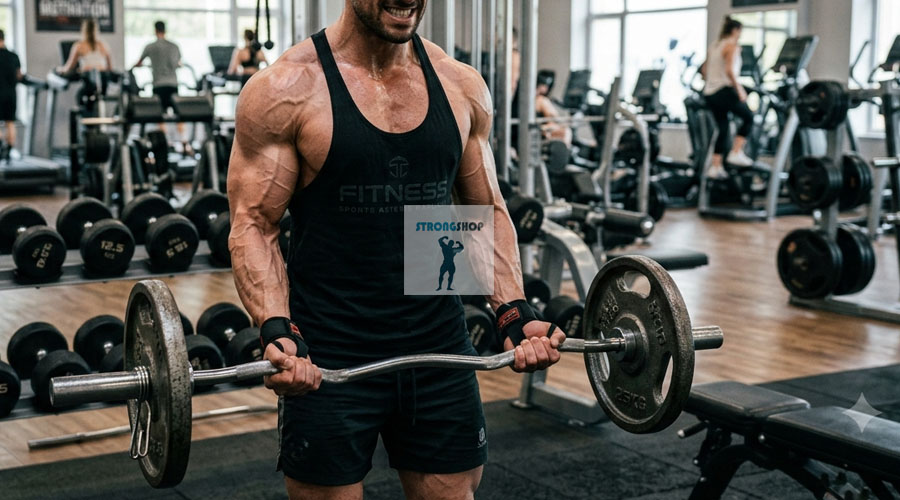
Pumping is a training method based on high volume and short rest periods to maximally fill muscles with blood. Behind the feeling of a "pump" lies a serious growth mechanism — metabolic stress.
What is Pumping in Bodybuilding
Pumping (from the word pump) is a training method in which a muscle contracts repeatedly with a relatively light weight and short rest between sets. As a result, blood actively flows into the muscle but cannot drain away as quickly — the muscle swells, becoming hard and warm. This is the pump.
Arnold Schwarzenegger described the pump as the best feeling in training. However, behind this feeling lies specific physiology and concrete growth mechanisms.
The pump is not just a "nice engorgement." It is a marker of metabolic stress — one of the three main mechanisms of muscle hypertrophy.
Why Metabolic Stress is Needed and How it Relates to Muscle Growth
Scientist Brad Schoenfeld highlights three primary mechanisms of muscle hypertrophy:
- ⚙️ Mechanical tension — heavy weight, low repetitions
- Metabolic stress — pump, lactate, high repetitions
- Muscle damage — DOMS (soreness), negative phase
Pumping purposefully targets the second mechanism. Here is what happens inside the muscle during a pump workout:
- Blood actively flows into the muscle while venous outflow is restricted — occlusion occurs
- Metabolites accumulate: lactate, hydrogen ions, inorganic phosphate
- These metabolites signal stress to the body and trigger anabolic processes
- Production of growth hormone and IGF-1 increases locally within the muscle
- Muscle cells swell with fluid — cellular swelling itself serves as an anabolic signal
Cellular swelling is one of the underrated growth stimuli. When a cell fills with fluid, the body perceives it as a threat to its integrity and enhances protein synthesis in response.
Pumping vs Strength Training: What's the Difference
⚡ Strength Training
- 1–6 reps
- 80–95% 1RM
- Rest 3–5 min
- Mechanical tension
- Neuromuscular adaptation
- Minimal pump
Pumping
- 8–30 reps
- 40–65% 1RM
- Rest 30–60 sec
- Metabolic stress
- Hormonal response
- Maximum pump
Hypertrophy
- 8–12 reps
- 65–80% 1RM
- Rest 60–90 sec
- Both mechanisms
- Classic BB
- Moderate pump
How to Perform a Pump Workout Correctly
Pumping is not simply "grabbing a light weight and doing high reps." There are specific parameters that make this method effective:
| Parameter | Value | Why |
|---|---|---|
| Weight | 40–65% of 1RM | Sufficient for stress without limiting volume |
| Reps | 15–30 per set | Creates the necessary metabolite accumulation |
| Rest | 30–60 seconds | Blood doesn't have time to drain from the muscle |
| Sets | 4–6 per muscle group | Volume is required to accumulate stress |
| Tempo | Controlled, no cheating | The muscle should work, not momentum |
| Range of Motion | Full or partial at peak | Partial reps enhance the pump |
Pumping Tools
Special techniques are used to enhance metabolic stress:
- Supersets — two exercises back-to-back without rest. The pump builds up exponentially.
- Drop sets — after failure, reduce weight by 20–30% and continue. Squeezes the muscle to its limit.
- Giant sets — 3–4 consecutive exercises for the same muscle group without rest.
- Peak contractions — 1–2 second hold at the point of maximum contraction.
- Partial reps at the end — when full repetitions are no longer possible, perform partials in the top third of the range.
Gironda's 8×8 Method — Systematic Pumping
One of the most famous pumping methods in bodybuilding history is Vince Gironda's "8 by 8" system. Gironda was a trainer of champions back in the 1960s and 70s, calling his method "honest" training without unnecessary weight or cheating.
The essence: 8 sets of 8 repetitions with short rest periods of 30–45 seconds between sets. Weight is approximately 60% of working weight. No failure, perfect form, continuous muscle tension.
What the 8×8 method provides:
- Huge total volume — 64 reps per exercise
- Sustained pump throughout the entire workout
- Works exceptionally well for lagging muscle groups
- The workout fits into 45–60 minutes
Detailed breakdown of Gironda's method, history, and ready-to-use routine:
Vince Gironda's 8×8 Method: How to Make Lagging Muscles Grow →Where to Place Pumping in Your Routine
Pumping is not a replacement for heavy strength work, but a supplement to it. Integration options:
- At the end of a strength session — after heavy compound movements, finish the muscle with a 2–3 exercise pump block
- Separate pump day — light recovery workout between heavy sessions
- Alternating weeks — heavy week / light pump week. Works well in periodization
- For lagging muscle groups — an extra pump session targeting weak points 1–2 times per week
Need a powerbuilding program with pump blocks tailored to your goals and level? I will design a personalized training plan.
Get a Program from a TrainerMistakes During Pump Workouts
- Excessive weight — technique breaks down, pump disappears, load shifts away from the target muscle
- Long rest periods — blood leaves the muscle, metabolic stress fails to accumulate
- Cheating and momentum — muscle isn't working; the pump is created by movement, not contraction
- Only pumping without compounds — without mechanical tension, growth will be limited
- Ignoring nutrition — without adequate carbohydrates, the pump will be weak
Frequently Asked Questions
Is a pump real growth or just water in the muscles?
Both, but they aren't mutually exclusive. During the workout, yes — it is blood and fluid. But the metabolic stress generated by the pump triggers real anabolic signals: growth hormone, IGF-1, cellular swelling. The long-term outcome is genuine hypertrophy.
Can you build muscle with pumping alone without heavy weights?
Up to a certain level, yes. However, for maximum growth, both mechanisms are required: mechanical tension (heavy compound lifts) and metabolic stress (pumping). Pumping alone is insufficient for experienced athletes.
How long does a pump last after a workout?
The visible pump lasts 30–60 minutes post-workout. Cellular swelling and related anabolic processes continue longer — for several hours.
Does pumping help with fat loss?
Indirectly, yes. High volume and short rest elevate caloric expenditure during the workout and cause excess post-exercise oxygen consumption (EPOC). However, pumping is primarily a tool for muscle growth, not a dedicated fat burner.
Why is Gironda's 8×8 method better than regular pumping?
The 8×8 method is a structured system with precise parameters, making it easy to monitor and progress. Regular pumping can be chaotic. Gironda created a method that provides consistent volume without the risk of overtaxing — especially beneficial for lagging muscle groups.
Pumping is not merely an enjoyable sensation in the gym, but a full-fledged hypertrophy tool operating through metabolic stress. Use it as a supplement to heavy foundational lifts, experiment with Gironda's method on lagging body parts — and you will master a toolkit utilized by the finest bodybuilders of the last 60 years.