


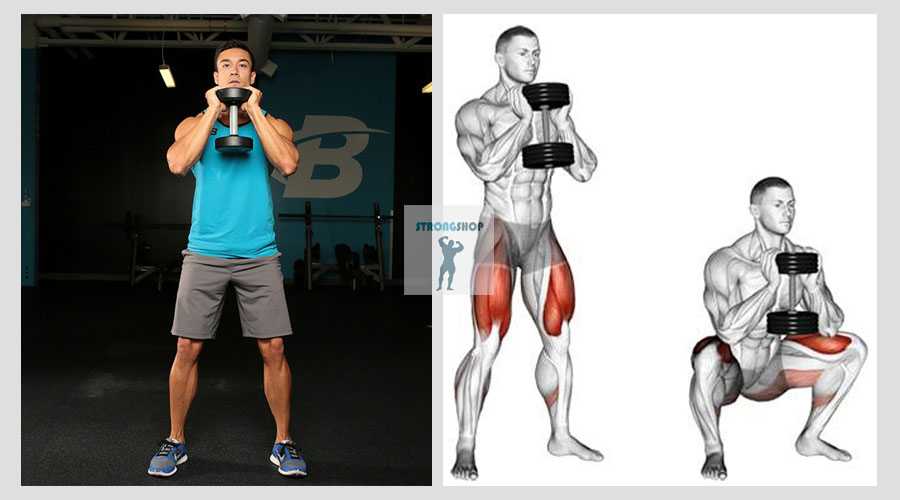
The goblet squat is a foundational exercise for the legs and glutes, performed while holding a dumbbell or kettlebell in front of the chest.
It combines safety, technique control, and effective lower-body loading, making it suitable for both beginners and experienced athletes.
The goblet squat is often used to teach proper squat form, improve mobility, and strengthen the core muscles without axial overload on the spine.
Contents
- Uses and Benefits
- Muscles Worked
- Technique
- Similar Exercises
- Common Mistakes
- Place of the Goblet Squat in a Program
Uses and Benefits
The goblet squat is an exercise that serves several purposes at once:
Learning Squat Technique
Because the weight is held in front, the center of gravity shifts forward, which helps you:
- keep your back straight,
- maintain a neutral spine position,
- avoid falling backward.
This makes the exercise ideal for mastering the classic squat.
Safe Load on the Spine
Unlike barbell squats, the goblet squat:
- creates less axial load,
- is easier to control,
- reduces the risk of technical errors.
Developing Mobility
The exercise helps:
- improve hip joint mobility,
- open up the thoracic spine,
- learn a deep range of motion.
Core Strengthening
Since the weight is held in front of the body, the core muscles are actively engaged for stabilization.
Muscles Worked
The goblet squat is a multi-joint exercise for the lower body.
Primary muscles worked:
- quadriceps (front of the thigh)
- glutes (gluteus maximus)
- hip adductors
Additionally engaged:
- hamstrings
- core muscles (rectus and transverse abdominis)
- spinal erectors
- upper back muscles (for holding the dumbbell)
In terms of mechanics, the exercise falls into the category of basic leg exercises rather than full-body, despite the active work of the stabilizers.
Goblet Squat Technique
Starting Position:
- Hold a dumbbell or kettlebell with both hands.
- Hold it vertically at chest level.
- Elbows pointed down.
- Feet slightly wider than shoulder-width, toes turned slightly out.
Movement:
- Inhale.
- Begin the movement by pushing your hips back and down.
- Lower to parallel or below (with sufficient mobility).
- Knees track in line with the toes.
- Keep the back neutral.
- Exhale as you return to the starting position.
Important: don't round your lower back or lean forward.
Similar Exercises
If you want to vary your leg workout or find an alternative, consider:
- Plié squats
- Sumo squats
- Bulgarian split squats
- Dumbbell squats (weights at sides)
All of these exercises load the leg muscles but differ in foot placement, load emphasis, and difficulty level.
Common Mistakes
Even a simple exercise can be performed incorrectly.
Rounding the Back
Most often caused by insufficient mobility or too much weight.
Knees Caving Inward
Caused by weak glutes or lack of movement control.
Rising Onto the Toes
Shifting the weight forward disrupts balance and reduces effectiveness.
Too Much Weight
The goblet squat is an exercise for technique and control, not for maximal weight.
Place of the Goblet Squat in a Program
The goblet squat is a versatile exercise that can be integrated into training at different stages of preparation.
For Beginners
As the main foundational exercise for learning squat technique and establishing a proper movement pattern.
During Recovery or When Experiencing Back Discomfort
Due to the lower axial load on the spine, the goblet squat can be a gentler option compared to the barbell squat (provided there are no contraindications and after consulting a specialist).
As an Accessory Exercise After Heavy Squats
Used to "finish off" the quadriceps and glutes in a moderate-to-high rep range (10–15) when maximal loading is no longer needed.
In the Technical Correction Phase
Helps improve squat depth, core control, and knee tracking.
In Functional or Home Training
Suitable for workouts with limited equipment — a single dumbbell or kettlebell.
Conclusion
The goblet squat is an effective foundational exercise for developing the quadriceps, glutes, and core muscles. It's well-suited for learning technique, improving mobility, and safely training the legs without axial load on the spine.
Thanks to its simplicity and high effectiveness, the goblet squat remains one of the best exercises for beginners and an excellent accessory movement for experienced athletes.
Goblet Squat FAQ
Is this exercise suitable for beginners?
Yes, it's one of the best exercises for learning proper squat technique.
Can you build your legs with just this exercise?
In the initial stage — yes. For progress over time, you'll need to increase the load or move to heavier variations.
Which is better — goblet squat or barbell squat?
For learning technique and safety — the goblet squat. For maximal strength development — the barbell squat.
Is this a full-body exercise?
No. Despite the work of the stabilizers, the primary load falls on the leg muscles.
Links to Authoritative Sources
https://www.youtube.com/watch?v=g16Qv_P1nNE
https://www.youtube.com/watch?v=3eP9ZkvnH5Y