


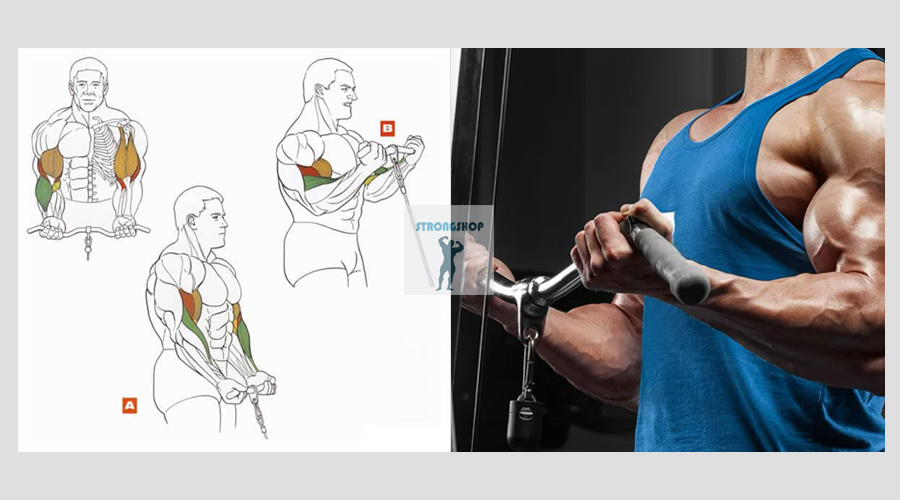
Cable bicep curls are one of the most effective isolation exercises for developing the biceps brachii.
Unlike free-weight curls (barbell or dumbbells), working on a cable machine creates constant tension on the muscle throughout the entire range of motion, which improves the quality of muscle engagement.
The cable version lets you vary the loading angles, change handles, and adjust body position, creating different emphasis on individual heads of the biceps. This makes cable curls a versatile tool both for building mass and for fine-tuning arm shape.
Contents
- Uses and Benefits
- Muscles Worked
- Technique
- Common Mistakes
- Place in Training
Uses and Benefits
This exercise is used in both mass-building programs and cutting/definition training. It's mainly used in bodybuilding.
Key Benefits:
Constant tension. The cable creates continuous load at every point of the range of motion, including the top and bottom positions, where free-weight training loses tension.
Controlled trajectory. The cable sets a clear path of movement, reducing the chance of cheating.
Wide range of variations. You can change the pulley height, the handle type (straight bar, EZ bar, rope), and perform the movement with one or both arms.
Joint-friendly. The smooth resistance of the cable puts less strain on the elbows and ligaments.
Excellent pump. Constant tension creates powerful blood flow, stimulating hypertrophy.
Convenient for drop sets. Weight can be changed quickly just by moving the pin in the stack.
Muscles Worked
Cable curls are an isolation exercise with clear focus on the target muscle.
Primary Muscles Worked:
Biceps — the main target muscle. Both heads (long and short) get even loading with a classic grip. The long head works harder with a narrow grip, the short head with a wide grip.
Brachialis — located underneath the biceps, it assists in flexing the elbow joint. It's well activated with a neutral grip (palms facing each other).
Brachioradialis — a large forearm muscle that acts as a synergist. It engages more with a reverse grip or when using a rope handle.
Forearm muscles — the wrist and finger flexors work statically to hold the handle.
Front deltoids — provide minimal stabilization of the shoulder joint, especially in variations from a high pulley.
Load distribution depends on grip type, pulley height, and elbow angle. By experimenting with variations, you can emphasize different parts of the biceps.
Cable Bicep Curl Technique
The classic version from a low pulley with a straight bar.
Starting Position:
- Attach a straight bar handle to the low pulley of a cable crossover machine
- Stand facing the machine, 30-40 cm away
- Grip the handle with an underhand grip, shoulder-width apart
- Step back to create tension on the cable
- Feet shoulder-width apart, knees slightly bent
- Torso upright, elbows tucked in at your sides
- Arms nearly straight (keeping a slight bend)
Execution:
- Bend your elbows, pulling the handle toward your chest
- Elbows stay fixed in place — only the forearm moves
- Hold a peak contraction at the top (1 second)
- Lower the handle under control, don't let the weight drop
- At the bottom, keep tension on the muscle without fully straightening your arms
Key Points:
- Elbows locked at your sides
- Torso stationary, no swinging
- Shoulders stay down, not shrugged
- Movement driven by the biceps, no body jerking
- Breathing: exhale on the curl, inhale on the lowering phase
Common Mistakes
Swinging the torso. Using body momentum to lift the weight is a classic mistake. It reduces the load on the biceps and increases the risk of lower back injury. Keep your torso locked in place and work only with your arms.
Elbows drifting forward. When the elbows move forward during the curl, the front deltoids take over some of the work, taking tension off the biceps. Keep your elbows fixed at your sides.
Shrugging the shoulders. Raising your shoulders engages the traps and reduces effectiveness. Keep your shoulders down and relaxed throughout the set.
Dropping the weight. Fast, uncontrolled lowering kills all the benefit of the negative phase. Lower the handle slowly, controlling every inch.
Fully straightening the arms at the bottom. This releases tension from the biceps and can strain the elbow joint. Keep a slight bend in your elbows.
Using too much weight. Trying to lift the maximum weight leads to broken form and cheating. Choose a weight you can do 10-12 clean reps with.
Overbending the wrists. Curling the wrists inward overloads the forearms and can cause pain. Keep your wrists in a neutral line with your forearms.
Place in Training
As a primary bicep exercise on light training days or when working on definition.
As an accessory movement (2nd-3rd in order) after heavy barbell bicep curls to finish off the muscle. As a finishing exercise in pump sets for maximum blood flow.
Variations:
- Low pulley with a straight bar — the classic version for general development.
- Low pulley with an EZ bar — reduces strain on the wrists, more comfortable for many athletes.
- Low pulley with a rope handle — the neutral grip activates the brachialis.
- Single-arm from a low pulley — lets you focus on each arm individually and correct imbalances.
- Double-arm from high pulleys — mimics a double-bicep pose, strong contraction at the peak of the biceps.
- Hammer curls on the cable — emphasizes the brachialis and forearms.
Training Schemes:
For mass: 3-4 sets of 8-12 reps with moderate weight and a controlled tempo.
For definition: 3 sets of 12-15 reps with light weight and a slow negative phase.
Pumping: 2-3 sets of 15-20 reps with minimal rest (30-45 seconds).
Drop sets: 1 set to failure, then reduce the weight by 30% and continue to failure 2-3 times.
Combining with Other Exercises:
Works great in supersets with cable triceps extensions for a maximum arm pump. Can be combined with hammer-grip dumbbell curls for complete development. Makes a good finisher after barbell and dumbbell bicep curls.
Conclusions
Cable curls are an effective isolation exercise with constant muscle tension. Benefits: controlled technique, joint safety, plenty of variations, and an excellent pump. Suitable for mass, definition, and detail work. Follow proper technique, focus on the feel in your biceps — results won't be far behind.
FAQ
How are cable curls better than barbell curls?
The cable creates constant tension throughout the entire range of motion, while with a barbell the tension drops at the top due to gravity.
Which handle should I use?
Start with a straight or EZ bar at shoulder width, then experiment with the rope and single-handle attachments for variety.
Can this exercise be my main bicep movement?
Yes, especially on light days or when working on definition, but for building mass it's better to start with heavy barbell curls.
What weight should I choose?
One you can do 10-12 clean reps with, without swinging or cheating — usually around 15-30 kg.
Do I need to fully straighten my arms at the bottom?
No, keep a slight bend in your elbows to maintain constant tension on the biceps and protect the joints.
My wrists hurt during the exercise — what should I do?
Try an EZ bar or rope handle — they reduce wrist strain thanks to a more natural grip angle.
How often can I do cable curls?
1-2 times per week as part of an arm day or a back+biceps day, with at least 48 hours of rest.
Which is better — one arm or two?
Two arms for overall volume, one arm for focus and correcting imbalances — use both approaches.