

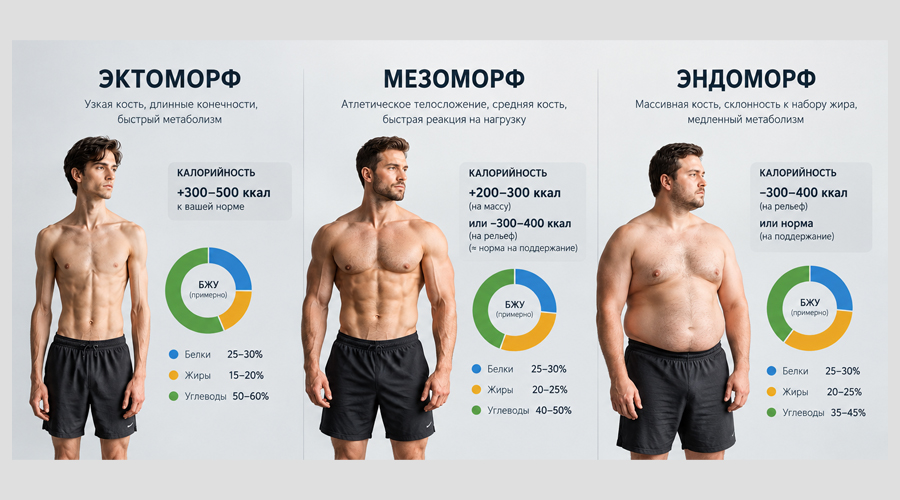
A diet for different body types (somatotypes) isn't one universal plan — it's three fundamentally different approaches to calorie intake, macro ratios, and meal timing.
An ectomorph needs an aggressive caloric surplus with an emphasis on carbs, a mesomorph needs a flexible balance built around a specific goal, and an endomorph needs a moderate deficit with controlled simple carbs and high protein. Let's break down each type honestly — with practice, not generic talk.
Why Divide People into Somatotypes at All
The concept of three somatotypes — ectomorph, mesomorph, endomorph — was developed by American psychologist William Sheldon back in the 1940s. Modern science clarifies: pure types almost never exist, and most people are mixed. But as a practical tool for dialing in nutrition and training, this classification works great.
The point is simple: different people get different results on the same diet. What barely maintains weight for an ectomorph will cause fat gain in an endomorph. Ignoring this means fighting your physiology instead of working with it.
To accurately calculate your starting calories for any somatotype, use the online calorie calculator.
Ectomorph: Eat More Than You Think
An ectomorph has a narrow bone structure, long limbs, thin wrists, and a fast metabolism. The main problem is that the body burns calories faster than you can create a surplus for growth. Ectomorphs often complain that they "eat a lot but don't grow" — and most of the time they're simply undereating relative to their actual energy expenditure.
Key diet principles:
What to add from sports nutrition: a mass gainer (high-calorie, with real complex carbs, not sugar), creatine, protein between meals. More details in the article Supplements for Muscle Mass Gain.
The ectomorph's biggest mistake: underestimating the real calorie content of their diet. Keep a food diary for at least the first 2–4 weeks — you'll be surprised how much less you eat than you think.
Mesomorph: The Most Rewarding Type, but with Pitfalls
A mesomorph has a naturally athletic build, medium bone structure, muscles that respond to training quickly, and moderate fat gain. This is the type everyone in the gym envies. But the mesomorph has a trap of their own: because "everything grows on its own," many relax and stop watching their diet — and drift toward endomorphy without noticing.
Key diet principles:
The mesomorph's main task is not to lose their natural advantage. Eat for your goal, control your calories, train consistently. When bulking — follow a bulking diet with a moderate surplus and no excessive fat gain. When cutting — a deficit plus mandatory strength training to avoid losing muscle along with fat. Read why strength training is critical even when losing weight in the article Why Strength Training Is as Important as Diet for Weight Loss.
Endomorph: Not a "Bad" Type, but a Type with Special Rules
An endomorph has a massive bone structure, a tendency to gain fat, a wide waist, and a slow metabolism. This isn't a sentence — it's a physiology you need to work with smarter, not harder.
The endomorph's biggest mistake is cutting carbs to zero and piling on cardio. This works in the short term, but it destroys muscle mass and slows the metabolism down even more. The right approach is a moderate deficit with high protein and strength training as the foundation.
Key diet principles:
Important: strength training for an endomorph isn't optional, it's a mandatory element. It speeds up the metabolism, preserves muscle mass in a deficit, and improves insulin sensitivity. Why Strength Training Is as Important as Diet for Weight Loss is a must-read if you're an endomorph and want to lose weight the right way.
Mixed Types — What to Do
Most people aren't pure types. You might be an ecto-mesomorph, a meso-endomorph, and so on. The rule is simple: determine which type dominates, and use its diet as your base. Then adjust based on results — your body's actual response matters more than any theory.
If you're not sure about your calorie needs, the online calorie calculator will help you calculate a starting point for your weight, activity level, and goal.
General Rules for All Somatotypes
FAQ
How do I accurately determine my somatotype?
Measure your wrist at its narrowest point. Up to 15 cm — ectomorph, 15–17 cm — mesomorph, over 17 cm — endomorph. This is the Solovyov index — a simple benchmark for bone structure size. Also pay attention to how your body responds: whether you gain weight easily or with difficulty, and how quickly fat comes off in a deficit.
Can an ectomorph eat simple carbs?
Yes — and this is one of the rare cases where simple carbs are justified. For an ectomorph, they help quickly replenish glycogen after training and support a caloric surplus. No need to overdo it, but no need to fear them either.
Can an endomorph not eat carbs at all?
No — that's a myth. Completely eliminating carbs kills training performance and slows the metabolism in the long run. Control the type and timing of your carbs instead of cutting them out entirely.
Does your somatotype change with age?
Your skeletal structure doesn't change, but the muscle-to-fat ratio does. After age 35, metabolic rate drops in all types — which means your diet needs to be revisited periodically regardless of somatotype.
If you want a diet built for your body type and specific goals — message me on Telegram: @dstechkh